
A smart TV box should do more than stream content. Storage, recording, live TV features, connectivity, and picture quality can all change how useful it feels in everyday use.
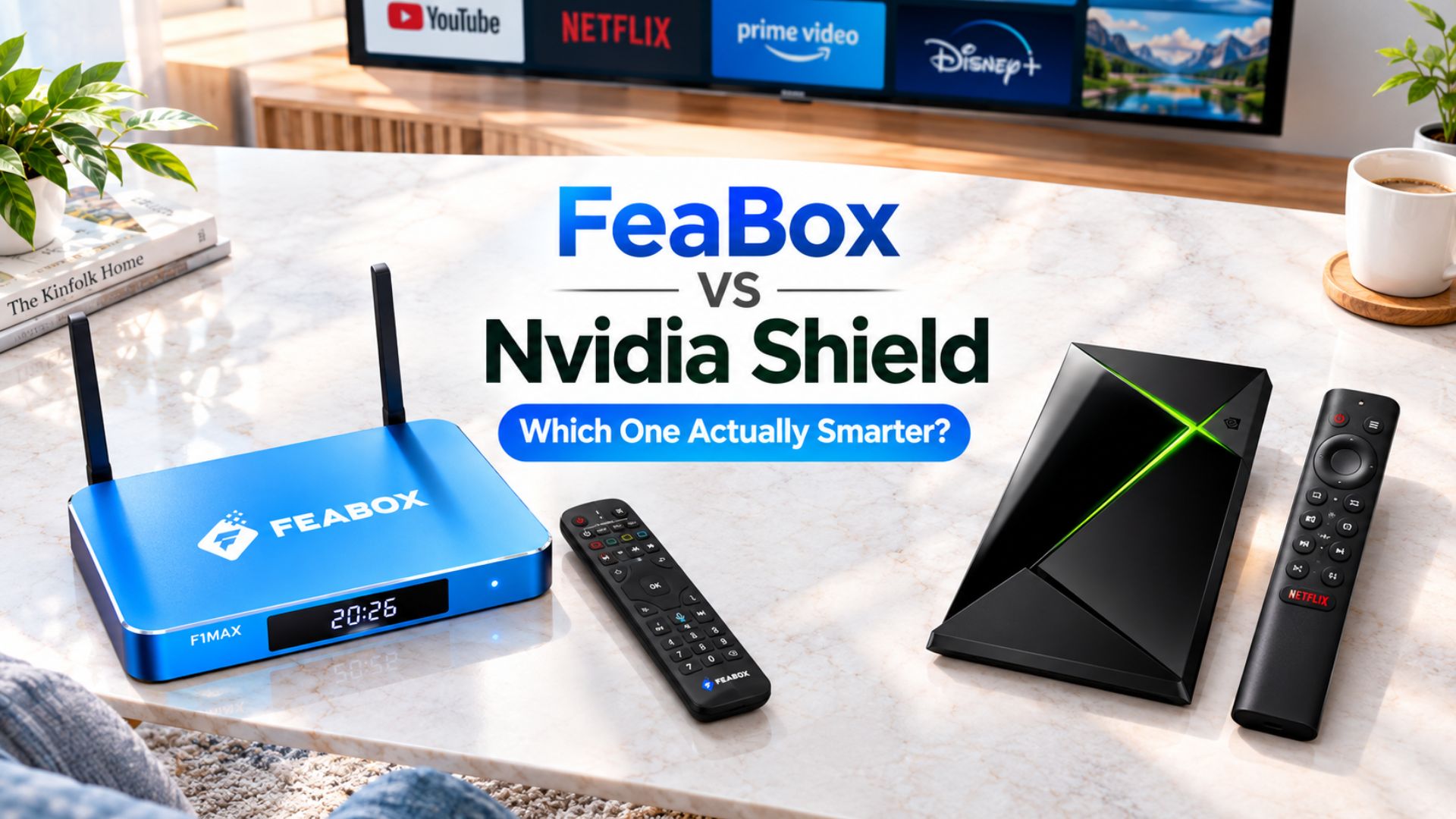
That is what makes the FeaBox vs Nvidia Shield comparison interesting. The FeaBox F1 Max focuses on storage and everyday TV features, while the NVIDIA Shield TV Pro puts more emphasis on AI upscaling, gaming, and home theater. So which one actually makes more sense for your setup?
FeaBox vs Nvidia Shield: What’s the Real Difference?
The easiest way to understand these two devices is to look at what they prioritize. The FeaBox F1 Max comes with 64GB of internal storage, integrated recording, 7 day Time Shift, Multi Screen, Picture in Picture, and TF card expansion. It is built for users who want more flexibility when watching, recording, and storing TV content.
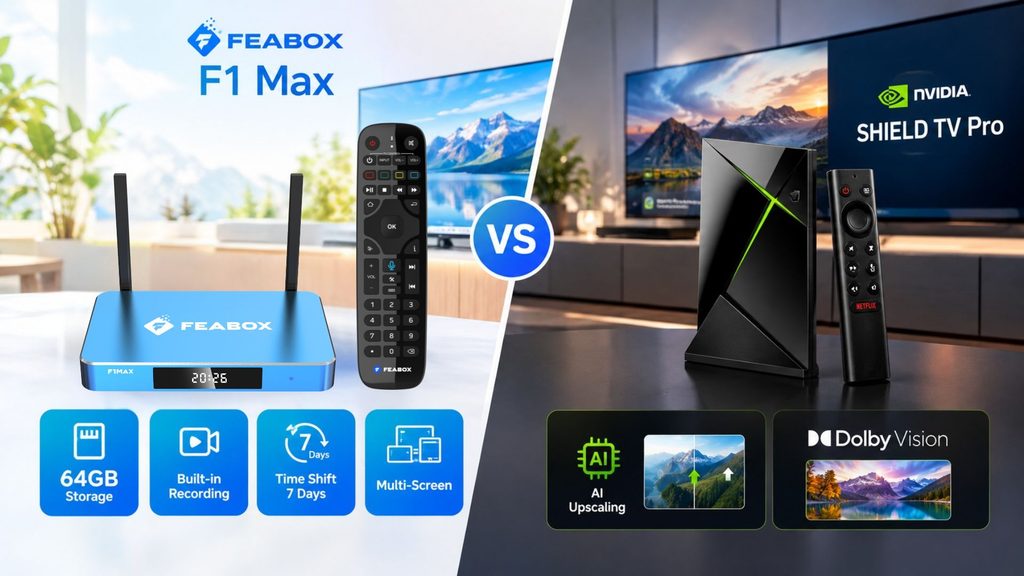
The NVIDIA Shield TV Pro comes with 16GB of storage but focuses on features such as AI upscaling, Dolby Vision, advanced audio, GeForce NOW, and Plex Media Server. Neither device tries to do exactly the same thing.
64GB vs 16GB: Which Gives You More Room?
Storage is one of the clearest differences. FeaBox F1 Max streaming box has 64GB of built in storage, compared with 16GB on the Shield TV Pro. That gives you more space for apps, recordings, and local files without immediately needing an external drive. The F1 Max also supports TF card expansion, so storage can be increased when your needs grow.
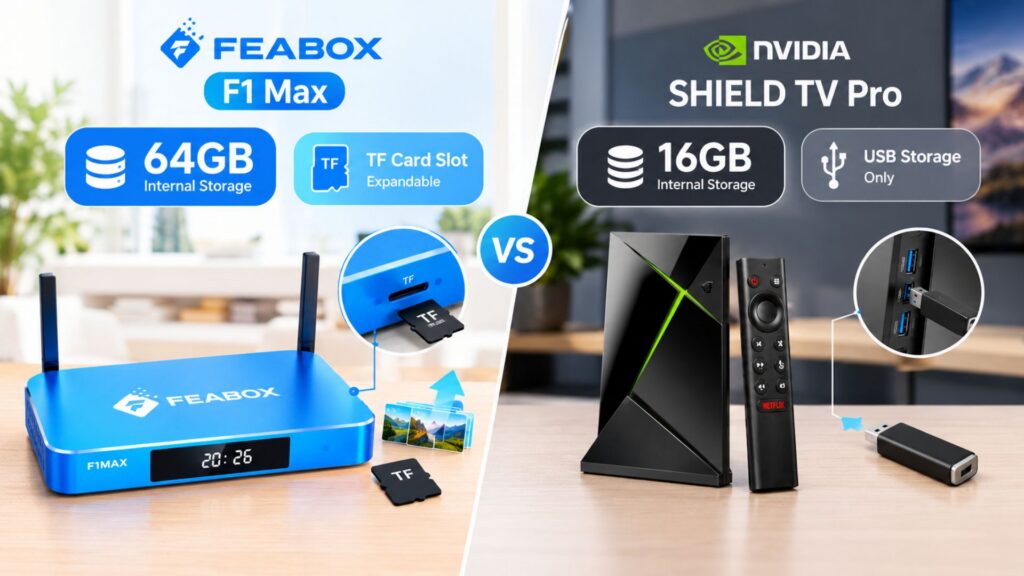
The Shield TV Pro uses its two USB 3.0 ports for external storage instead. For users who regularly record content or install multiple apps, having more storage built into the box can make everyday use simpler.
Recording and Time Shift: Two Features the F1 Max Brings Forward
Streaming is only part of the TV experience. The F1 Max includes integrated recording, allowing supported content to be saved directly to the device. Its 7 day Time Shift feature also lets users go back to earlier live TV content within the supported period. That can be useful when you miss part of a program or want more flexibility around live viewing.
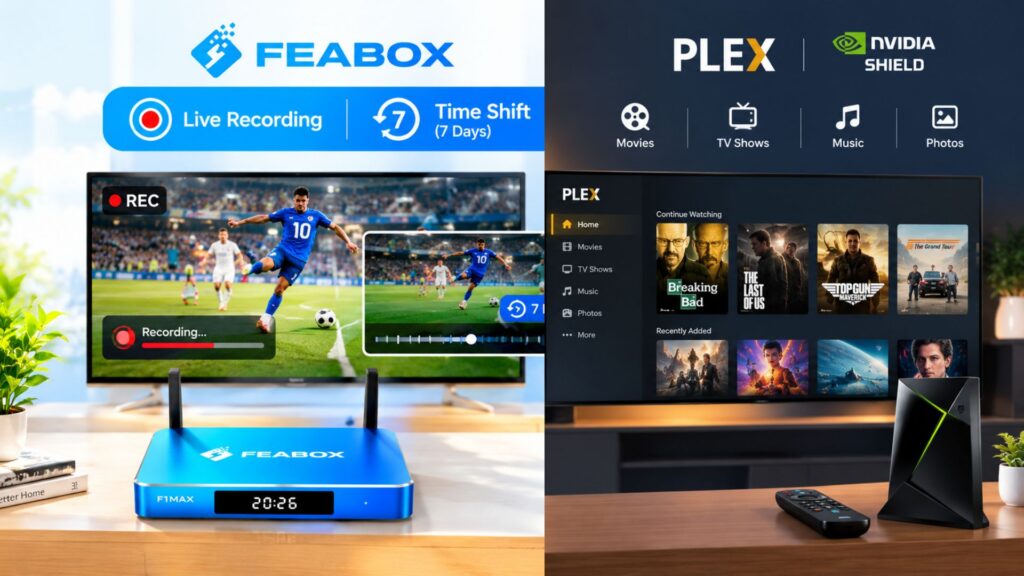
The Shield TV Pro takes a different approach. It is better known for running Plex Media Server, allowing users to organize and stream their own media library across a home network. So the difference is straightforward: the F1 Max puts more emphasis on recording and live TV flexibility, while the Shield is more focused on personal media management.
Where Nvidia Shield Has an Advantage
The Shield TV Pro has several features that will matter to a different type of user. Its AI upscaling can enhance lower resolution content when displayed on a 4K TV. It also supports Dolby Vision, Dolby Atmos, DTS:X, and other advanced home theater formats.
Gaming is another major part of the Shield experience. With GeForce NOW, PC game streaming, and Android games, the device can serve as more than a traditional streaming box. If your entertainment setup revolves around 4K home theater, gaming, or a personal media server, these features may be more relevant than additional internal storage.
FeaBox vs Nvidia Shield: Connectivity
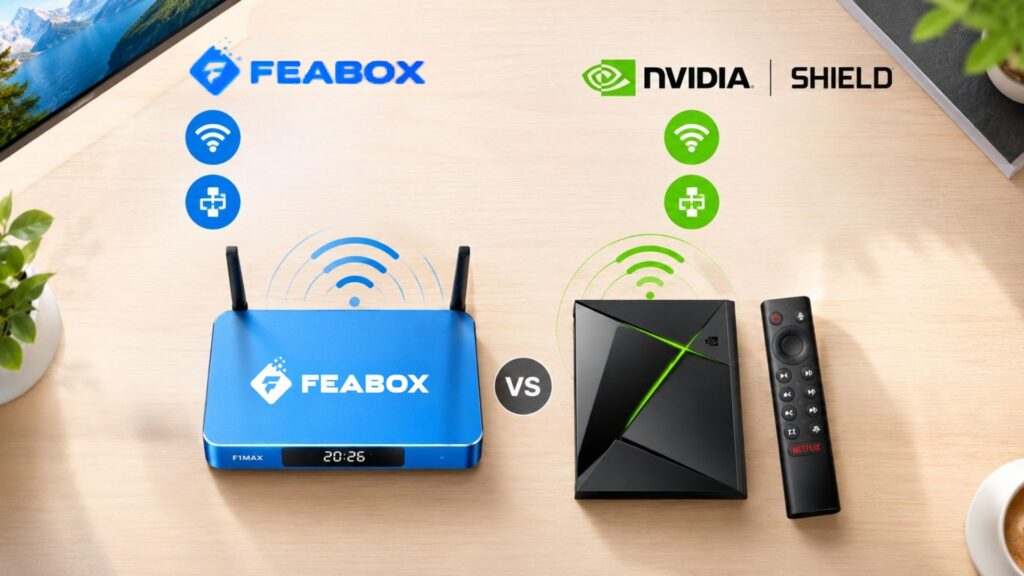
Both devices support Gigabit Ethernet, giving users the option of a wired connection. The F1 Max adds Wi Fi 6 dual band, USB 2.0, USB 3.0, HDMI, AV out, SPDIF, Bluetooth 5.2, and a TF card slot. The Shield TV Pro offers Wi Fi 5, two USB 3.0 ports, Gigabit Ethernet, HDMI, and Bluetooth 5.0. For everyday streaming, both provide the essential connection options. The F1 Max simply gives users more built in flexibility for wireless connectivity and storage expansion.
FeaBox vs Nvidia Shield: Quick Comparison
The biggest differences between the FeaBox F1 Max and NVIDIA Shield TV Pro come down to storage, everyday TV features, connectivity, and advanced home theater capabilities. The table below highlights the specifications and features that are most relevant when choosing between the two.
| Feature | FeaBox F1 Max | NVIDIA Shield TV Pro |
| Internal storage | 64GB | 16GB |
| Storage expansion | TF card | USB storage |
| RAM | 4GB | 3GB |
| Operating system | Android 12 | Android 11 |
| Wi Fi | Wi Fi 6 | Wi Fi 5 |
| Gigabit Ethernet | Yes | Yes |
| Integrated recording | Yes | Not a primary feature |
| Time Shift | 7 days | Not a primary feature |
| Multi Screen / PiP | Yes | Not a primary feature |
| AI upscaling | No | Yes |
| Dolby Vision | No | Yes |
| Gaming | Android apps | GeForce NOW, PC and Android gaming |
| Media server | No | Plex Media Server |
The comparison shows two different approaches to the TV box experience. The FeaBox F1 Max puts more emphasis on storage, recording, Time Shift, expandable memory, and convenient everyday TV use, while the NVIDIA Shield TV Pro focuses more on AI image processing, advanced audio and video formats, gaming, and media server functions.
For readers comparing different options beyond these two models, a fully loaded tv box comparison can also help put their features, storage, connectivity, and entertainment functions into a broader context.
Which One Is Actually Smarter?
For most people looking for a TV box for everyday entertainment, the FeaBox F1 Max offers a more practical package. Its 64GB storage, built in recording, 7 day Time Shift, TF card expansion, Wi Fi 6, and Gigabit Ethernet are designed around the way people actually watch, record, and manage TV content.
The NVIDIA Shield TV Pro still has strong features for dedicated home theater and gaming setups, especially with AI upscaling, Dolby Vision, Dolby Atmos, GeForce NOW, and Plex Media Server. However, those features may matter less to users who mainly want a convenient TV box with more storage and built in TV functions.
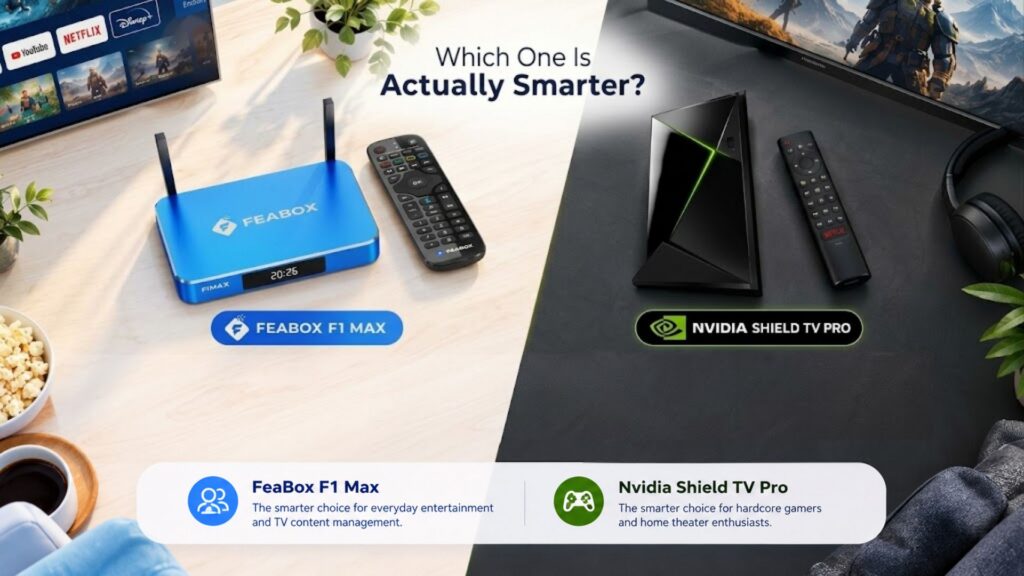
With its larger storage, recording capabilities, expandable memory, and everyday TV features, the FeaBox F1 Max gives users more flexibility without requiring a specialized home theater or gaming setup. For viewers who want a TV box that can handle more of their daily entertainment in one device, F1 Max is a compelling alternative to the older Shield TV Pro.
Final Thoughts
The FeaBox vs Nvidia Shield comparison ultimately comes down to what you expect from a TV box. Shield TV Pro remains a capable choice for users focused on high end home theater and gaming, but F1 Max takes a more practical approach to everyday TV entertainment.
With 64GB of storage, built in recording, 7 day Time Shift, TF expansion, Wi Fi 6, and a versatile selection of connections, F1 Max gives users more room to store content and more ways to control their viewing experience. For households that want convenience, flexibility, and useful TV features in one box, F1 Max is the more practical upgrade to consider.
Ready to Explore FeaBox F1 Max?
If you’re looking for the best streaming box for everyday viewing, recording, storage, and flexible connectivity, take a closer look at the FeaBox F1 Max and see what it can add to your home entertainment setup.